If I had to choose a king of hell, it'd probably be Satan regardless though. This is because he's so manipulative that he can manipulate the other devils! I mean that's pretty impressive. Like others have mentioned, with their new plan, the human race doesn't really stand a chance against a guy like Satan. He almost beat God for crying out loud!
Showing posts with label Team Tragedy. Show all posts
Showing posts with label Team Tragedy. Show all posts
Wednesday, November 16, 2016
Satan and the Devils
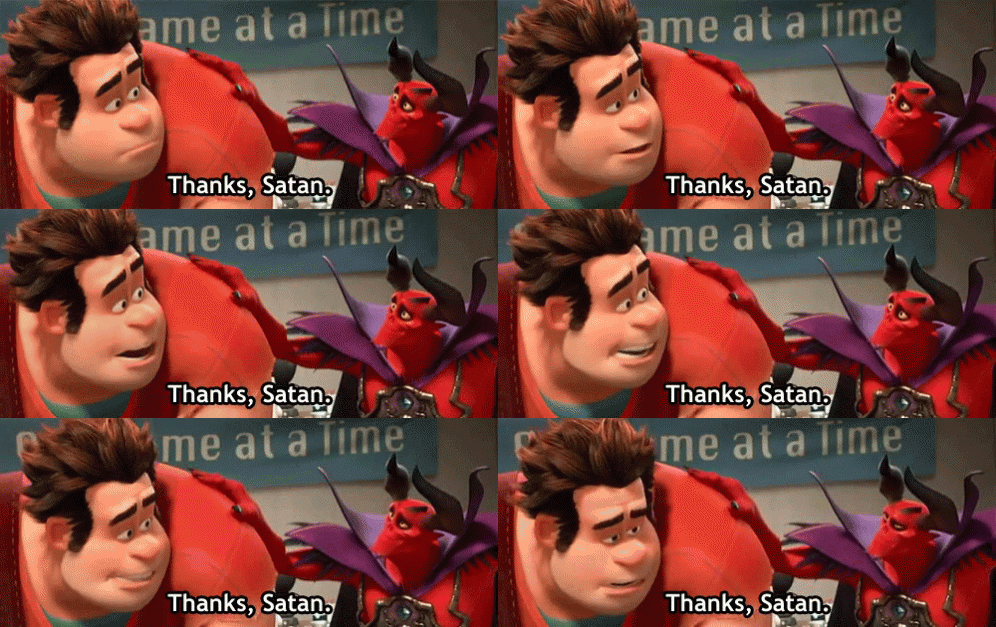
As I've said once or twice, before starting Paradise Lost, I really did not know what to expect. I knew it had to do something with Satan but I did not know we'd meet lots of devils in the process. I want to take a second to talk about the devils' discussion. I see it kind of like a huddle in football to discuss the next play. Of course there is always one player who ALWAYS gets the glory *cough cough quarterback* and in this case that person is Satan.... the king of Hell and all the Devils.
If I had to choose a king of hell, it'd probably be Satan regardless though. This is because he's so manipulative that he can manipulate the other devils! I mean that's pretty impressive. Like others have mentioned, with their new plan, the human race doesn't really stand a chance against a guy like Satan. He almost beat God for crying out loud!

If I had to choose a king of hell, it'd probably be Satan regardless though. This is because he's so manipulative that he can manipulate the other devils! I mean that's pretty impressive. Like others have mentioned, with their new plan, the human race doesn't really stand a chance against a guy like Satan. He almost beat God for crying out loud!

Monday, November 14, 2016
The Sore Losers of Hell
Alright, so it's clear from the beginning of Paradise Lost that the devils are the losers here. They lost a great battle with God and they all ended up being chained to a fiery lake of doom in Hell. Honestly, they should've just given up on it all and realized that God would always have the upper hand here. But of course, they had to make things difficult, because as my mother would say, "then there wouldn't be a story." Satan's buddies are all like, "wait, this isn't supposed to happen this way. We have to do something about this!" And he realizes that yeah, this situation ain't too cool.
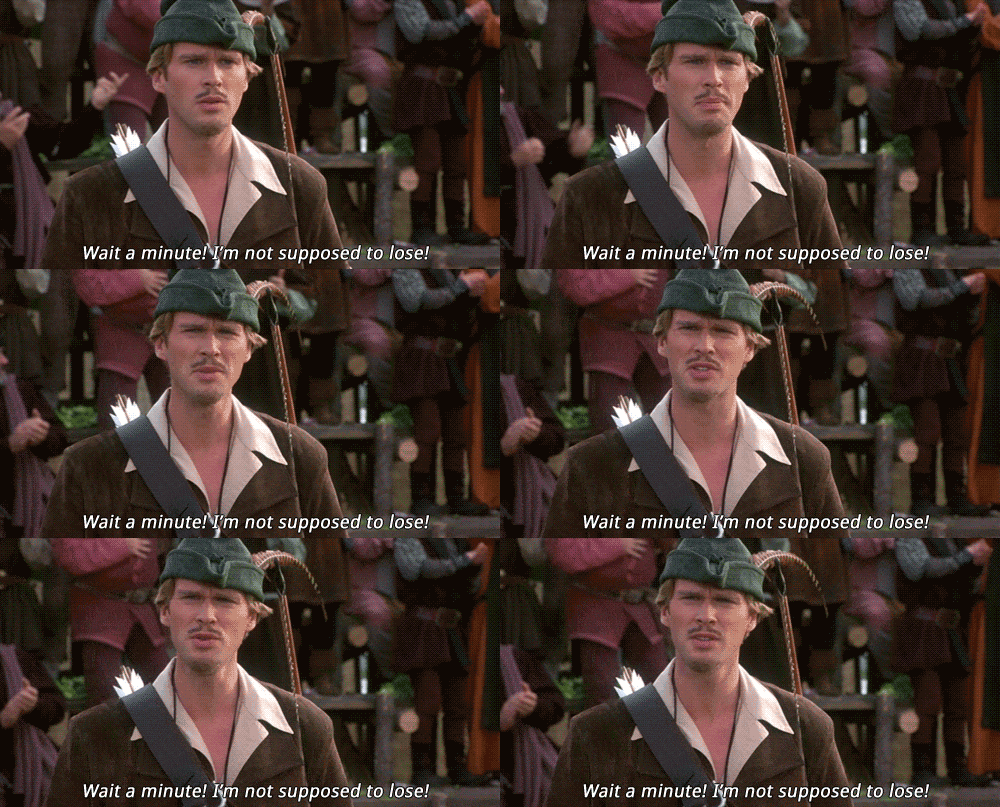
So basically they decide that they need to destroy God's latest and greatest creation: man. Which, I mean, is slightly annoying because it's like bro, we didn't do anything to you. But you know, whatever, this is Milton's world and we're just living in it. So anyway, the devils decide they need a volunteer and Satan's all like "ooh pick me! Pick me! I'll be the hero in this story!" As if anyone would've wanted this to happen differently.

So basically they decide that they need to destroy God's latest and greatest creation: man. Which, I mean, is slightly annoying because it's like bro, we didn't do anything to you. But you know, whatever, this is Milton's world and we're just living in it. So anyway, the devils decide they need a volunteer and Satan's all like "ooh pick me! Pick me! I'll be the hero in this story!" As if anyone would've wanted this to happen differently.
Anyway, so Satan goes to the gates of Hell and finds even more allies in his quest to screw up God's day. I mean, of course, this starts to become super incestuous and uncomfortable for all of us, so I'll just stop at that, but I'll leave you with this: Sin has been through one hell of a life, if you know what I mean.
Sunday, November 13, 2016
For God So Loved the World...
In Book Two, now that they're free to do as they wish in Hell, the devils debate over what course of action to take. Beelzebub comes up with the most-favored plan: destroy God's new world. With traditional stories about the beginning of Christianity in mind, the inclusion of this decision in Paradise Lost makes the story 100% more interesting. We are given a more lucid, logical reason as to why Satan makes his evils present on Earth and targets the human race.


The only problem is, representing Hell in the new world must be exactly what God wants Satan to do. I know I'm assuming that God is truly Almighty, but omniscient powers are part of his job description, so I don't think it's a bad assumption to make. God knows no one would care about getting into Heaven if there wasn't such a shitty alternative. I mean, "Heaven or nothing" sounds a lot less intimidating than "Heaven or Hell." It can't be pure coincidence that God damns Satan and his bros to Hell, unchains them, then creates a new world and allows them inside. He is definitely capable of stopping them whenever He wants, but He doesn't! Besides, who created Hell itself if not God? Maybe there's a backstory to the backstory somewhere out there, but I hope it's written by God himself. I have a few questions for the guy.

If there is a backstory to the backstory out there, I'm trying to find out how the gates to Hell were constructed. There's nine of them for Christ's sake (no pun intended), and they're guarded by who? Satan's asexual child named Sin who he sexually impregnated with Death, and Death raped sin? Did I get that right? What kind of monster rapes his sister/mom? This is so fucked up. Do I even need to mention how ironically irritating it is that Sin is the only female here? Like...alright, I don't know what you're trying to say, God, but it's fine. Just don't act like women aren't the best sin.
Anyways, my favorite part of Book Two is when Satan flies out of Hell and gets directions to Earth from his fellow dark, cosmic entities. I'm just imagining this whole thing playing out in real time. God's a few lightyears away saying, "Let there be light!" - his voice echoing through the universe while the fallen angels strap up for war. Somebody should make a movie out of this, if they haven't already. Honestly, it would be beautiful, and Morgan Freeman could still play God.

Paradise Lost by John Milton.
Wednesday, October 26, 2016
Something Wicked This Way Comes Indeed
Macbeth seems to be spiraling out of control. For some reason he just needs to kill EVERYBODY! Banquo saw it coming and hopes that at least Fleance can esacape to stop Macbeth's horrible motives.
I'm not sure I really understand why Macbeth decided to kill Lady Macduff and her children. Maybe just to be thorough? At this point I think he might just be killing to kill....or at least that's what it seems like. Perhaps he's just super paranoid because he couldn't just stay away from the witches. His power has definitely gone to his head.
I really liked how the witches described Macbeth before he entered. "Something wicked this way comes," is definitely accurate. I kind of see Macbeth as Voldemort in the sense that everyone that might compromise his power must die. Also, whenever I read that line that the witches say, I can't help but think what goes around comes around and "No one mourns the wicked."

I'm not sure I really understand why Macbeth decided to kill Lady Macduff and her children. Maybe just to be thorough? At this point I think he might just be killing to kill....or at least that's what it seems like. Perhaps he's just super paranoid because he couldn't just stay away from the witches. His power has definitely gone to his head.
I really liked how the witches described Macbeth before he entered. "Something wicked this way comes," is definitely accurate. I kind of see Macbeth as Voldemort in the sense that everyone that might compromise his power must die. Also, whenever I read that line that the witches say, I can't help but think what goes around comes around and "No one mourns the wicked."
Macbeth, you mad?
When I started reading Act 3, I got a feeling that the rest of the play might center around this idea that Macbeth's throne is not secure, which got me wondering - why doesn't he think about this before he murders Duncan? I guess Duncan's murder is so rushed on purpose; if it wasn't rushed, maybe somebody would have had the common sense to dissect the witches' riddles. The witches' original prophecy claims that Macbeth will be king and Banquo's family will eventually take the throne. Macbeth must only pay attention to his side of the prophecy. He reasons that the only way he can become king is if he kills the current one. If that's so true, how does he not reason that Banquo or someone must eventually kill him for the throne as well? I don't know how this tragedy ends, but if I had to make a guess...
Buuut I'm not here to make prophecies. That's what the witches are for! Macbeth goes back to the witches in Act 4 to seek more guidance, and I've got to admit, I really like Shakespeare's version of traditional witches here.

 |
| I think Macbeth is going to die. |
"Scale of dragon, tooth of wolf,
Witches' mummy, maw and gulf
Of the ravined salt-sea shark,
Root of hemlock digged i' th' dark,
Liver of blaspheming Jew,
Gall of goat and slips of yew
Slivered in the moon’s eclipse,
Nose of Turk and Tartar’s lips,
Finger of birth-strangled babe
Ditch-delivered by a drab,
Make the gruel thick and slab.
Add thereto a tiger’s chaudron,
For the ingredients of our cauldron."
(Act 4, Scene 1, Lines 22-34)
Double, double, toil and trouble, fire burn and cauldron bubble indeed. I mean, these bitches throw a Jewish person's liver and the finger of a baby who was born in a ditch to a prostitute and strangled to death into their stew. Shakespeare...what kind of sick were you...
Anyways, the witches show Macbeth a floating head, a bloody child, a crowned child, and a procession of eight kings where one holds a mirror and is followed by Banquo's ghost. I'm not too sure that I could unravel the meanings behind these apparitions accurately, but I'm curious to see how they play out. I'm especially curious as to how Macbeth is expected to fear Macduff yet "none of woman born shall harm [him]" (Lines 82-83). I think the witches ordered the prophecies that way on purpose so that Macbeth dismisses the first prophecy by understanding the second and concluding that he must kill Macduff: "Then live, Macduff. What need I fear of thee? But yet I’ll make assurance double sure, And take a bond of fate. Thou shalt not live..." (Lines 85-87). Gosh, these witches really are good at mind games. I like it.

Macbeth. William Shakespeare.
MVPs of Acts 3 & 4
The tragedy continues to unfold!

I do have
to say that my favorite moment from last night’s reading is when Fleance
escapes the murderers in Act 3 Scene 3. I’m sure it’s much more convincing when
performed onstage, but I read the murderers’ lines after Fleance fled to be
just kind of mildly disappointed in the whole situation.
“Aww, nuts. He got away.”
I’m also a big fan of Lady Macduff.
She is NOT shy about her feelings towards her husband after he fled! I was definitely
expecting her to be distraught and weepy after her husband left, and I was so
glad to be proven wrong. I love the boldness of the women in this story. It’s
so refreshing to see them asserting their opinions and beliefs. I think if the
whole murdery thing never went down, Lady Macbeth and Lady Macduff could have
been Co-Queens and brushed all of the men aside.
https://www.youtube.com/watch?v=FrLequ6dUdM
Of course I need to give a quick shout-out to the little Egg. He was so
positive about everything and knew that life would go on and God would provide!
Even his mother was taken aback by his can-do attitude. Major Tiny Tim vibes!
(Of A Christmas Carol fame. Not the creepy
tulip guy.)
http://www.magichcs.com/wp-content/uploads/2015/04/cracked-egg.jpg
RIP Little Buddy
Lastly, I think it’s pretty amusing that Malcolm starts hyping Macduff to
kill Macbeth the moment they find out Lady Macduff and the rest of the
household were murdered. There’s no “hey
I’m really sorry that your family is dead” from Malcolm, it’s just Killing
Time. While I can respect that he has the courage to immediately act upon his
desires, I still think Malcolm would be the guy to shout commands from behind
the camera while shakily filming schoolyard brawls in portrait mode.
Overall, I’m really excited to keep
reading this, because I’m certainly enjoying it more than I ever did in previous
readings. I think my new appreciation
for the women in the story majorly contributes to my enjoyment, because I
remember being thoroughly annoyed by Lady Macbeth while reading this in middle
school. What an egg I was.
Tuesday, October 25, 2016
The Return of Banquo
Okay, so let's just get this out in the open from the very beginning: Shakespeare loves his paranormal characters, doesn't he? I mean, I'm not complaining because the return of Banquo is pretty badass. Yeah, of course, he doesn't do much but sit in a chair and scare the crap out of Macbeth, but honestly, that was just enough to me. Oh, did I mention that he's a ghost and that no one other than Macbeth can see him? Because that's even better.


So yeah, Lady Macbeth is trying to save her husband's reputation by telling his guests that he's really just messing with them... Right. Whatever you say, Mrs. M.
Anyway, in the meantime, Macduff gets word that Banquo is dead and even though most people are saying that Fleance is the murderer, old Macduff knows better. He's all like, "I know that jerk Macbeth is behind this, and I'm gonna make him pay for it." Pretty cool of him to take it upon himself to right the wrongs that Macbeth has inflicted on Scotland, and eventually, on his own family. But hey, I mean, that's cool Macduff. You go, man. You get that revenge.
Basically at the end of our reading for the night, Macbeth is visited by even more apparitions (as if he didn't sound crazy before) and one of them told him that he could not be harmed of any man who was woman-born. Hmm... (Insert obvious foreshadowing sign here) I wonder what's going to happen next.
Wednesday, October 12, 2016
What's Perfect? You Decide

'The land is so well distributed that each city has at least twenty miles of it on every side, and on some sides more, where the towns are farther apart...A Phylarch rules over every thirty houses." (Pg. 59)
"Besides agriculture, which as I said is common to all, each person is taught some craft...everyone, man and woman alike, learns one of these crafts." (Pg. 64)
Based on More's recounts, Utopia might look similar to a mandala geographically and systematically. The towns and the people are virtually identical and everything centers around one common core: agriculture, just like a mandala is symmetrical from any degree and has a common center. From there, variation exists in craft, which is organized by category and interconnected with other, larger factors of the whole, and the whole pattern blooms outward. Everything is connected, communal, and equal. This kind of Utopia looks perfect.
Of course, perfection doesn't always look the same...

If more than one "perfect mandala" can be drawn, who's to say we can't create more than one "perfect society?" The only reason we disagree over what's perfect and what's not is because variation is a fundamental part of human nature, and rightfully so. More's Utopia doesn't try to eliminate variation, it just equalizes it. Other "perfect societies" could equalize things differently and still look perfect. I wonder - could Utopia look imperfect?

We have to understand that perfection is actually vague and left open to interpretation for each individual person, so perfection can even look like imperfection to you, me, and everyone else all at once. In the context of societies, maybe variation doesn't have to be categorized and equalized at all. Maybe it could be left alone and emphasized.
I don't know what my Utopia would look like, but I know the distinction between Utopia and Dystopia is one and the same with the distinction between perfection and imperfection: vague and left open for interpretation for each individual person. It's interesting to see what people believe is perfect or not and how well that translates into reality.
Utopia. Thomas More.
They Cheated? Off With Their Head!
Okay, so here's the thing: Utopia is just straight-up weird. I mean, it's kind of cool but it's just very, very different. The people there seem cool as hell, and it would probably be a pretty interesting place to live, considering the short work days and emphasis on staying in shape.


The thing that I found the most interesting would probably be the fact that the Utopians execute those who have cheated twice. In some cases, I think that would be a little excessive, but at the same time, giving someone that grace period in the beginning and chalking it all up to a mistake would probably be the best way to make them understand that what they did was wrong. I almost agree with killing them on the second offense... Almost.
Anyway, there are some other interesting aspects of Utopia as well, like the fact that they really don't fight unless provoked and hate war altogether. Their society seems to work so well that maybe we should rip a page from their book... But of course I'm sure we'd find a way to screw up that way of life as well.

I Wonder If Utopia Has a National Anthem...
Utopia seems like a great and ideal society, however I do not think all of their ideas are for me. In addition to that, it makes me wonder how much country pride they have. Are they as proud to be from Utopia as we are to be Americans?
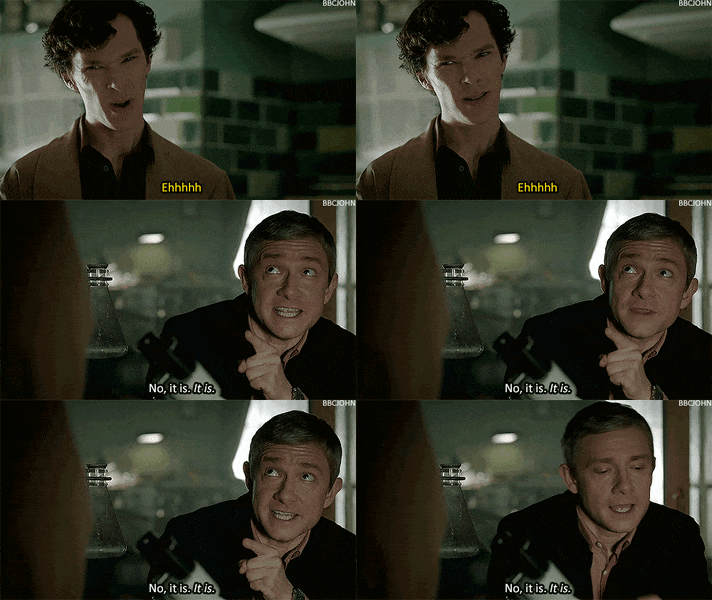
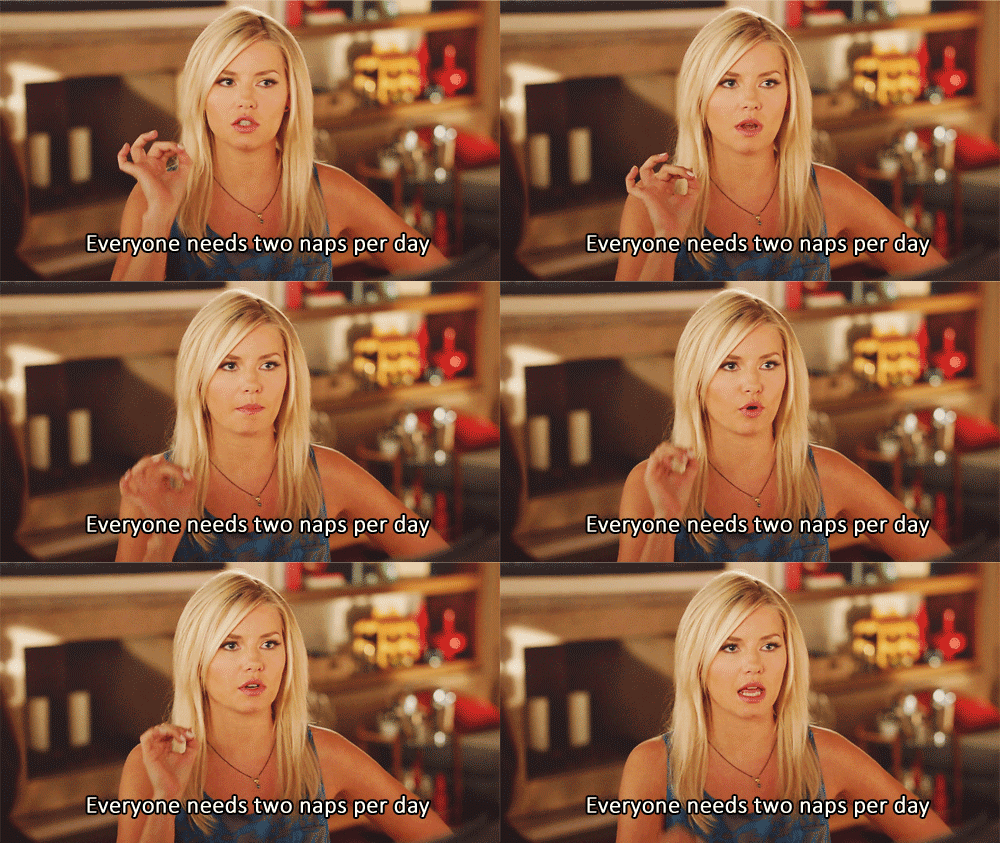
I personally do not want to have all of my days and activities planned for me (although I like the idea of scheduled naps because sleep is a beautiful thing). Sometimes a little spontaneity is fun and a good thing in my mind!

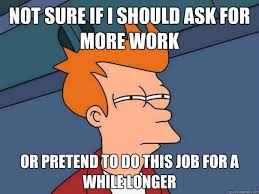
In regard to work, I'm not sure how they managed to get people to work for the same amount. That might work for them, but I don't think it'll work as well in many other places. I will say, though, that a 6 hour work day sounds amazing! The reason I'm not sure this society will always work is because it reminds of a communist society. Yes, I know it works, but I also know that many people dislike it and flee to other countries because of it. People need incentive to work and improve. That's not going to work as well if everyone is getting paid the same amount for different (and possibly more difficult) jobs.

Side note: It also makes me think about the society in The Giver because everything was planned out for them too.

I personally do not want to have all of my days and activities planned for me (although I like the idea of scheduled naps because sleep is a beautiful thing). Sometimes a little spontaneity is fun and a good thing in my mind!
In regard to work, I'm not sure how they managed to get people to work for the same amount. That might work for them, but I don't think it'll work as well in many other places. I will say, though, that a 6 hour work day sounds amazing! The reason I'm not sure this society will always work is because it reminds of a communist society. Yes, I know it works, but I also know that many people dislike it and flee to other countries because of it. People need incentive to work and improve. That's not going to work as well if everyone is getting paid the same amount for different (and possibly more difficult) jobs.
Side note: It also makes me think about the society in The Giver because everything was planned out for them too.
Tuesday, October 4, 2016
Exactly Who's Utopia is This Going to Be?
Before I dig into the political meat of Book One, I'd like to point out something subtly noted in the letter Thomas More sent to Peter Giles. Basically, More admits he didn't ask the first thing most cognitively functioning human beings ask when a location is described to them, "where is it?" Even more conveniently, Raphael Hythloday forgot to mention it, which makes no sense considering the first chapter of Book Two is literally titled "Geography of Utopia." I cheated a little and flipped forward to see how specific the geography gets otherwise, and let me tell you, it's pretty specific. It just makes me wonder - why was the detail of Utopia's exact location left out? I know More actually coined the term Utopia in reality. Was he trying to metaphorically announce that Utopia didn't exist but could exist anywhere?

Sidebar: I just Googled "Raphael Hythloday" (to make sure I was spelling it correctly because I was too lazy to pick up the book) and according to some website called Grade Saver, "Raphael" is the name of a Biblical angel, but "Hytholoday" means "peddler of nonsense." What the heck? Why would More choose this name for the fictional man who's sole role is to explain things that are apparently not nonsense?
Anyways, I read through all of Raphael's political stances, ideas, concepts, solutions, or whatever you'd like to call them, and agreed with some but disagreed with others.
Agree: Capitol punishment is practically pointless because it eliminates the criminals, not crime. In addition, the punishment of death won't stop a thief who steals to put food on the table for his family. The system almost manufactures these kinds of thieves, then blames them, and why should they be punished with the same intensity as murderers?
Disagree: Private property should be abolished and replaced with communal property to create more prosperity. I disagree with this because I study psychology and I understand that private ownership is considered a right to individualistic people, and you would definitely decrease prosperity if you took it away from those who have had it and told those who didn't get a chance to have it that they never will. More also disagrees with Raphael but claims that communal property would leave no room for prosperity because the people will have no incentive to work, then they would disrespect authority. Well, I also disagree with More. There are plenty of societies in history we can look at who have abolished private ownership, and prosperity wasn't dead and gone, it was just equalized among members of society.
I might have this backwards or entirely wrong, but Raphael sounds consistenently liberal throughout Book One while his opposers sound conservative. I wonder if Raphael's/More's Utopia is going to be more liberal than conservative, especially since More wrote himself as a character who expresses disagreement with Raphael's ideas. Isn't Utopia different for every single person anyways?
Remember: Utopia is defined as an "imagined place or state of things"...DEFINED as IMAGINED...

Utopia by Thomas More.
Wednesday, September 21, 2016
The Wife of Bath Will Not Take Your Nonsense
This being my first experience with
Middle English, I have to admit that reading The Canterbury Tales has been a bit
daunting. Much like the training wheels on my first bike, the footnotes and
helpful hints in the margins have been the only things keeping me from falling
flat on my face and crying to my mom.


How I feel reading Middle English
Aside from my struggles with the
language, I’m really looking forward to reading more of these characters’
tales! This concept of a storytelling contest brings me back to the days of
trying to one-up each other’s campfire stories at Girl Scout camp. Since many
of these characters seem a bit grittier (@Somonour) than most of the girls in
my Brownie troop, I’m sure these tales will entertain to say the least.

http://www.optionated.com/wp-content/uploads/2013/12/936full-scary-stories-to-tell-in-the-dark-cover.jpg
Anyone else guilty of peddling these stories as their own?
After reading the Prologue of the
Wife of Bath’s Tale, I’m definitely ready to hear more of what she has to say!
I’m a big fan of her saucy attitude, and I love how she’s always got some
biblical knowledge to back up her choices.

http://tattooimages.biz/images/gallery/Great_only_God_can_judge_me_quote_tattoo_on_arm.jpg.pagespeed.ce.jq5-vimJD3.jpg
Tell 'em, W.O.B.
Sure she’s been bouncing around
from husband to husband since she was a preteen, but at least she owns it! I
would love to see another character try to confront her about her choices,
because I’m certain she would serve up a vicious verbal take-down, and honestly
I’m here for it.
Wife of Bath 2016: Make Canterbury
Saucy Again
Chaucer, Geoffrey. The Canterbury Tales. N.p.: W.W. Norton &, n.d. Print.
Tuesday, September 20, 2016
#JustWifeyThings
The Wife of Bath tries to establish
herself as an experienced wife, but
the only thing she’s actually experienced with is sexual manipulation… I love
it, especially with the concluding details of her fifth marriage. Of course,
women want what they can’t have, and the Wife of Bath knows this, but she still
falls in love with her fifth husband, Jankyn, because she can not control him
the way she wants to. Regardless of the domestic violence and psychological
abuse involved, the Wife of Bath and Jankyn are great for each other because
they balance each other out. I’m so glad she actually fell in love with him. I
mean, her philosophies on love in her first four marriages are awfully sad, most
likely because she had never experienced true love, and how could she?
They had me yeven
hir gold and hir tresoor;
Me neded nat do
lenger diligence
To winne hir love,
or doon hem reverence.
They loved me so
wel, by God above,
That I ne tolde no deyntee of hir love! (Lines 204-208)
To
top it all off, Jankyn is twenty years younger than her… I’m not going to lie;
I find that detail erotic and captivating not just because it’d be my dream as
a single, old lady to score some youthful babe but it adds to my astonishment
over this woman’s mere existence. It was common for an older man to marry a younger woman, but was it common for an older woman to marry a younger man? I didn't think so...
She must represent a whole bunch of woman that actually existed in Chaucer's time with similar thoughts, feelings, and
behaviors when it comes to schemas about Church, marriage, sex, feminine roles,
and money. I want to hear the voices of these women! I don’t care for the argument
that women like her are the first “feminist” characters. Uh, I don’t think
she’s too concerned with feminism: the advocacy of
women's rights on the grounds of
political, social, and economic equality
to men (thanks for the definition, Google). She doesn’t mention a need
for women’s rights and she definitely isn’t trying to achieve equality with men
– if anything, she’s trying to achieve jurisdiction over men. I think the Wife
of Bath is just a badass nympho that doesn’t conform to the typical perspectives
women in her time were taught to take and, in turn, needed to fine the right
guy for her, and she did. In my opinion, she can’t even translate to a feminist
character.
My mental image of the Wife of Bath during her first four marriages:
 |
| Fionna Goode from American Horror Story, especially in the episode with the axeman ;) |
And during her fifth:
 |
| Lucy from I Love Lucy, mostly because she and Ricky are both hot-tempered and crazy, but they love each other <3 |
Geoffrey Chaucer, "The Canterbury Tales." Edited by V.A. Kolve and Glending Olson. Second Norton Critical Edition.
Subscribe to:
Posts (Atom)