Wednesday, October 19, 2016

Lady Macbeth is Crazy


This is my second time reading Macbeth and I have to say that I am enjoying it more this time around. Part of that comes from listening to the amazing voices from the Folger’s Shakespeare app, but either way. I never fully appreciated the character that is Lady Macbeth, she is quite gutsy. It is because of Lady Macbeth that Macbeth even seriously considering killing King Duncan. As soon as she hears that there is a possibility her husband could become king, she has already planned the murder in her head.  

smile creepy evil child smirk 
Lady Macbeth sees her husband as this wimpy fellow simply because he is not willing to do what needs to be done to make himself king. Macbeth almost backs out of the plan to murder to Duncan because his loyalty to him begins to get the best of him. When Lady Macbeth hears that he is not going to kill Macbeth she flips outs. She believes that if he is unable to kill Duncan, then he should not be able to see himself as a man.

                                    Image result for lady macbeth meme 


She is quite a strong woman and if she was not trying to get to the throne by killing the current king, she would be an interesting queen to have. She seems to have a lot more guts than Macbeth does, but in a dangerous way. In a way that if she was given too much power, then she might just be willing to abuse it.  
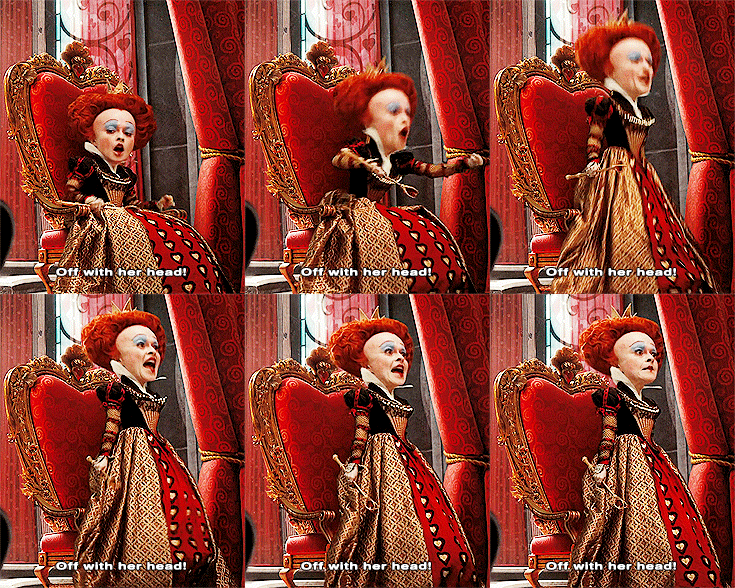
                                            helena bonham carter queen of hearts off with her head tim burton alice in wonderland

The Witches Macbeth

I know I am not alone among those who are always intrigued by the role of the witches in Macbeth. They have become such iconic figures that they are one of the easier ways to distinguish the play from the others of Shakespeare, but there is so much more to them than that.


Image result for three witches

Opening with the witches is an effective device because it sets the mood to be eerie and unnerving, similar to how the ghost functions at the beginning of Hamlet. Both of these supernatural phenomenon prophetically appeal to the titular character in order to drive the plot of the play. 

However, the witches are in some ways less mysterious than the ghost of King Hamlet, because early in the first act their prophecies are confirmed to at least hold grains of truth, revealed first to the audience and then to the characters of the play. It is significant that Macbeth's first words of the play "So foul and fair a day I have not seen" echo back to the witches' line in scene 1:"Fair is foul, and foul is fair." This immediate correlation between Macbeth and the witches indicates the power of their prophecies and anticipates the power they will have over Macbeth. Macbeth is much more stricken by the words of the witches than his friend Banquo, who begs to be included in the witches' predictions but does not feel as consumed by them as Macbeth. 

Shakespeare's use of paradox and prophecy together is a brilliant literary combination of techniques, because it entices the subjects (or perhaps victims) into obsessing over their respective futures, trying to accommodate the details of their lives to those described by the witches. Needless to say, it won't end well for anyone, because, you know, that's what happens in tragedies and also whenever witches or prophecies are involved.  


How about this time, you don't do the thing?

This is not the first time I am reading Macbeth, but what I am experiencing the first time in reading it is a desire for the story to go differently. In this first act alone, three, maybe four, of my margin notes amount to “No. Don’t do the thing. Stop what you’re doing.”

But I can only wish so much. Macbeth and Lady Macbeth are going to do the things. All of the things. (Centuries-old spoilers; I still won’t spoil them if you don’t know.)

Only in this reading have I realized how quickly the Macbeths consider killing King Duncan an option. Macbeth is ambitious, to be sure: the witches speak Macbeth’s desires for power. (So there’s your answer, Banquo: Macbeth starts “and seems to fear / Things that do sound so fair” (I.3.52-53) because he is surprised to hear his desires spoken aloud. He probably hasn’t even thought about these desires in actual words.) But think about it! As soon as Macbeth internalizes that he is thane of Cawdor as well as thane of Glamis, he thinks something very troubling. He asks himself, “Why do I yield to that suggestion / Whose horrid image doth unfix my hair / And make my seated heart doth knock at my ribs / Against the use of nature?” (I.3.138-141) I don’t know, Macbeth. Why do you jump so quickly to the idea that you might have to kill someone, despite your visceral regrets? Who thinks of such a thing so quickly? Who considers it a viable option?!

You’re not a disturbingly romanticized anime trope, Macbeth, so there’s no excuse. (Not pictured: the girl who was with the boy before the other girl killed her.)

At least Macbeth has regrets and reservations about it. At least he has more than a mere semblance of humanity. His wife, on the other hand, is eager to give up her humanity to get what she wants. “Fill me, from the crown to the toe, top-full / Of direst cruelty” (I.5.32-33)? If Lady Macbeth has any shred of humanity left in her, she wants it gone, wiped clean from her. It is a disturbing and yet fascinating depiction of someone willingly giving up her humanity to do evil. The disturbing aspects make me want to tell Lady Macbeth to stop as soon as she is done reading her husband’s letter, but the fascinating aspects are what make reading her lines so fun. Why, the moment she finishes reading the letter, she laments about the “milk of human kindness” holding her husband back (I.5.4). Goodness, who raised this woman? She considers violence even more quickly than he does, and chooses it! Well, if both think so similarly, perhaps they are well matched. If nothing else, they are a strong power couple. Would that they’d turn their efforts to pretty much anything else. . . .

Macbeth and Lady Macbeth: basically Bonnie and Clyde.


I pledge that I have neither given nor received any unauthorized aid on this assignment.

Tuesday, October 18, 2016

three witches

I think I am going to focus on these witches, because they are literally the reason this book even became a thing. How on earth do three random and creepy women telling you that you are going to be the "Thane of Cawdor," entice you to go and kill the current one. 

Rational thoughts make me think maybe you should just wait till he dies on his own, maybe it was going to be soon even if they didnt want him murdered. I dont really think that killing the king was  neccessary for the prophecy to come true, I think it would just make it happen faster and that isnt needed! It is so crazy and irrational. 


But I have never known Shakespeare to write something rational, so there is no surprise there. All I know is, they took a prophecy serious from three women and it lead to murder just to climb to the top. It seems as if people just arent happy with one thing but they want everything. It is directly related to society today! People are selfish and greedy and will do anything even if it lacks morality to get to the top.


Even Lady Macbeth thinks that this murder has to happen, she even thinks he lacks the power to kill Duncan, and it blows my mind that she is siding with this. Women are usually the smart ones! 

The Shakespearean Woman

Interestingly, looking at systemic misogyny (particularly in American culture) has been a common theme in many of my courses this week. As part of this idea, I have been looking at the way woman characters are written and comparing/contrasting the the way women are written by male writers vs female writers, as well as the time period of the literature and how that plays a role in the ideas about women in society.

As an example, I have been reading William Faulkner and Toni Morrison in a Writers of Significance course. Although these authors share a lot of stylistic elements in their writing, the role of female characters is one of their largest differences.

Morrison's novels frequently surround the idea of womanhood/motherhood and focus on the strength and perspectives of such characters. Faulkner on the other hand writes primarily male driven plots where the women characters are less dynamic.

Leading into Macbeth and Shakespearean play-writting, Lady Macbeth is the only female character we see early on in Act 1 of the play. Not surprising and before getting to see very much of her character it might be easy to assume that she is just the "token" woman, serving only as the main character's wife. In plenty of other plays of this era (Marlowe's Tamburlaine, Thomas Kyd's The Spanish Tragedy, and both Shakespearean plays I've read: Romeo and Juliet and Hamlet) we see few female roles, all of whom were played by men in actual performances at the time, that display woman as troubled, weak, unable to control themselves, inane, hysterical, and even subservient to men. In both of these Shakespearean plays we see women characters take their own lives. While there are male characters that also end their own lives, it seems to be that the men do it for prideful or fearful reasons (somehow more rational) where women do it in states of hysteria. My biggest point is that many of these female characters are specifically made to seem weak and unable to take care of themselves.

Now reading Macbeth, we have an initially surprising lead female role. While she is still the only woman in a play full of male kings and nobles that control all of what is happening, behind the scenes it seems as if Lady Macbeth is a more interesting (and devious) character than a lot of the woman written in other fifteenth century plays. Lady Macbeth is currently pulling the strings in her plot to have Macbeth murder King Duncan, assuming this will bring her and her husband to more power. Unfortunately, seeing this surprisingly strong female character is still made less significant because she is immoral and corrupt, implying to me that the woman who are not "in their place" or hysterical and unable to control themselves are secretively malicious and unjustly in search of power they don't deserve. And, to further the terribly misogynistic writing of the woman, *SPOILER* Lady Macbeth "goes crazy" and kills herself in the end... So we aren't fully given a character who gives even a shot at redemption in the crafting of the woman character.
Says: "Was Lady Macbeth naturally evil, or was she just portraying someone she wanted to be?"  How do you think Shakespeare would respond to this question about his character? Even in this question we see an obvious conundrum because either way Lady Macbeth is displayed negatively as evil or desperate. 

It's definitely important to remember that the era this play was written in certainly did treat women differently in society and is drastically different than the era we live in, however I can't say the women in our media are represented fairly even today (google The Bechtel Test if you're curious of an example). These representations in plays and all kinds of writing are definitely windows into the societal perspectives of the time-period in which they were written.

So These Three Witches Came up to Me...

       One day Macbeth and Banquo are just walking along when BAM, these witches appear out of nowhere and proclaim to them that they are going to be kings. Now if I were them, I would be really freaked out and probably run in the opposite direction. The news that they would be kings probably helped them not to run away though. Banquo was definitely more suspicious of the witches than Macbeth but I think this could be because Macbeth wanted to be king more than Banquo. I wonder why the witches told them this information in the first place? Banquo mentioned how they might have told them because it would lead to their demise which I think is a real possibility but maybe there could be an alternative reason.

       Once Macbeth hears the prophecy, it seems to be all he can focus on. When King Duncan tells how the Prince of Cumberland has been named heir to the throne, Macbeth realizes that he stands in his way of the prophecy coming true. I don't know what his plans were for the prince but I can't help to think that Macbeth would not consider such a plan had the witches not told him that he would be king in the first place.

       I find Lady Macbeth to be very power hungry and scary. As soon as Macbeth tells her of the prophecy, she automatically starts to plan King Duncan's murder. Why get rid of the prince when you can just go all the way and kill the king, right? It sounds really messed up when she tells Macbeth of her plan to kill him and just tells Macbeth to act natural and like a little flower when he comes over to their home.
How Macbeth is supposed to act before the murder

       Upon thinking over his wife's plan, Macbeth realizes that the act of murder doesn't just end when the person is dead but comes with lasting consequences. He realizes how messed up it would be to kill Duncan considering how much Duncan trusts him and how he has never wronged him. When Macbeth tells his wife that he changed his mind and didn't want to kill him anymore, Lady Macbeth became really mean. First, she calls him a scared little kitty. Then she says how she would bash out her own child's brain while it was breastfeeding from her looking up and smiling, if that is the promise she made to him so he shouldn't go back on his word to her. I think after being chewed out, Macbeth acquiesced to her plan because he was afraid of her and kind of still was thinking about how great it would be to be king. After what she said, I would be afraid of her too.

Lady Macbeth

Macbeth

Finally...

Oh man, I've been itching to get to this reading. This is what I have been looking forward to the most for this class.

So it is with great joy that I dive into the Scottish play for the seventh or eighth time. I've seen at least two film versions of Macbeth, and the witches are by far the creepiest in the Patrick Stewart version. Witches as nurses? Guaranteed instant goosebumps.

Whenever I read Shakespeare, I always find something knew in his plays that I hadn't seen or paid much attention to before. For this reading, it was in Act 1, Scene 3, Line 125-126. Macbeth says in an aside "Glamis and Thane of Cawdor! The greatest is behind". There is so much which can be unpacked in this one little phrase.

The first is the more obvious. He has achieved Thane of Glamis, Thane of Cawdor, and the greatest, according to the witches, is yet to come. That's pretty easy to see at face value. But this time, the word "behind" stuck out to me. If this first meaning was all that Shakespeare intended, it would have made much more sense to say "ahead". But he says "behind".

My interpretation of this is that Shakespeare is doing some fore-shadowing for us. It's his way of quietly telling us that Macbeth will begin a decline in his character. At this point in the play, he's pretty squeaky clean as far as his character goes. He's heroic, just, and a good soldier who is loyal to King Duncan. But this is as good as he gets. From here, he begins his descent into a pretty rotten person who does some equally rotten deeds. I hadn't thought to see this line that way before, which is one of the reasons why I love reading Shakespeare plays. Every reading is a new adventure.

One question I have always had about this play concerns the witches. Do they really have the power of prophecy? Or was Macbeth just taking the ramblings of three weird old ladies into his own hands? Was it destiny? Or was it all Macbeth? Truth be told, I don't know. I've never been able to come up with a satisfactory answer.

I love the wording in this play. I really do. One of my favorite parts in this act is the First Witch's story about the chesnuts. The phrase "rump-fed runion" (Act 1, Scene 3) is way more satisfying than "fat pig". Shakespeare is full of excellent insults to store for a rainy day.

On a final note, Lady Macbeth is by far my favorite character in the play. She is so deliciously evil. She's also an incredibly strong female character, at least in this part of the play. When she taunts her husband in the final act, my inner self could not help but rub her hands together in glee. She is so vicious. "Was the hope drunk wherein you dressed yourself? Hath it slept since? And wakes it now to look so green and pale at what it did so freely? From this time such I account thy love" (Act 1, Scene 7). You can feel the venom dripping off the page.

As always, I can't wait to read more. On with the show!